Showing posts with label moon. Show all posts

Wednesday, December 21, 2016

Tuesday, January 20, 2015

New Moon

New Moon today

- wong chee tat :)

Monday, January 5, 2015

Full Moon

Full Moon on Monday

- wong chee tat :)

Sunday, August 7, 2011

New Moon Dates

New Moon Dates

New Moon for January, 2011
  • January 4, 09:03
New Moon for February, 2011
  • February 3, 02:31
New Moon for March, 2011
  • March 4, 20:46
New Moon for April, 2011
  • April 3, 14:32
New Moon for May, 2011
  • May 3, 06:51
New Moon for June, 2011
  • June 1, 21:03
New Moon for July, 2011
  • July 1, 08:54
  • July 30, 18:40
New Moon for August, 2011
  • August 29, 03:04
New Moon for September, 2011
  • September 27, 11:09
New Moon for October, 2011
  • October 26, 19:56
New Moon for November, 2011
  • November 25, 06:10
New Moon for December, 2011
  • December 24, 18:06

- wong chee tat :)

Monday, March 7, 2011

Full Moons in 2011

Here is the schedule for all the Full Moons that will happen in 2011. If you’re going to go skywatching, remember that the best time to see the night sky is when you have a new moon. When there’s a full moon, the dimmer skies are washed out. Please note that all the times listed are in Universal Time.
Full Moon for January, 2011
  • January 19, 21:21
Full Moon for February, 2011
  • February 18, 08:36
Full Moon for March, 2011
  • March 19, 18:10
Full Moon for April, 2011
  • April 18, 02:44
Full Moon for May, 2011
  • May 17, 11:09
Full Moon for June, 2011
  • June 15, 20:14
Full Moon for July, 2011
  • July 15, 06:40
Full Moon for August, 2011
  • August 13, 18:57
Full Moon for September, 2011
  • September 12, 09:27
Full Moon for October, 2011
  • October 12, 02:06
Full Moon for November, 2011
  • November 10, 20:16
Full Moon for December, 2011
  • December 10, 14:36

- wong chee tat :)

Thursday, October 7, 2010

Phases of the Moon: 2010 UT

Year      New Moon       First Quarter       Full Moon       Last Quarter          ΔT


 2010                                                         Jan  7  10:40      00h01m
        Jan 15  07:11 A   Jan 23  10:53     Jan 30  06:18     Feb  5  23:49    
        Feb 14  02:51     Feb 22  00:42     Feb 28  16:38     Mar  7  15:42    
        Mar 15  21:01     Mar 23  11:00     Mar 30  02:25     Apr  6  09:37    
        Apr 14  12:29     Apr 21  18:20     Apr 28  12:18     May  6  04:15    
        May 14  01:04     May 20  23:43     May 27  23:07     Jun  4  22:13    
        Jun 12  11:15     Jun 19  04:30     Jun 26  11:30 p   Jul  4  14:35    
        Jul 11  19:40 T   Jul 18  10:11     Jul 26  01:37     Aug  3  04:59    
        Aug 10  03:08     Aug 16  18:14     Aug 24  17:05     Sep  1  17:22    
        Sep  8  10:30     Sep 15  05:50     Sep 23  09:17     Oct  1  03:52    
        Oct  7  18:44     Oct 14  21:27     Oct 23  01:36     Oct 30  12:46    
        Nov  6  04:52     Nov 13  16:39     Nov 21  17:27     Nov 28  20:36    
        Dec  5  17:36     Dec 13  13:59     Dec 21  08:13 t   Dec 28  04:18 


Eclipse Types
Solar Eclipse Lunar Eclipse
T - Total t - Total (Umbral)
A - Annular p - Partial (Umbral)
H - Hybrid (Annular/Total) n - Penumbral
P - Partial  
 
 
- wong chee tat :) 

Thursday, July 23, 2009

370 solar eclipse enthusiasts in Singapore stay indoors due to rain

370 solar eclipse enthusiasts in Singapore stay indoors due to rain
By Jessica Yeo, Channel NewsAsia

SINGAPORE : 370 Singaporeans gathered at the Singapore Science Centre to catch the solar eclipse on Wednesday morning, but they ended up staying indoors because of the rain which resulted in poor visibility.

10 per cent of the eclipse could have been seen in Singapore between 8:41am and 9:43am, with its optimum position at 9:11am.

The next eclipse is expected on 15 January 2010, and Singaporeans will be able to catch 30 per cent of it.

But Singapore will have to wait until 2019 for the annular eclipse if residents want to see the moon's shadow totally cast on the sun.

"The eclipse is caused by the moon casting a shadow on the Earth and this time round, the path of the shadow passes through the densely populated areas in China. Singapore happens to be literally at the fringe of the activity," said Dr Chew Tuan Chiong, CEO of Singapore Science Centre.

- CNA /ls

- wong chee tat :)

Tuesday, July 21, 2009

Singapore to experience minimal effects of upcoming solar eclipse

Singapore to experience minimal effects of upcoming solar eclipse


S’pore to experience minimal effects of the upcoming eclipse

SINGAPORE: Come Wednesday, China, India and Japan will be seeing its longest total solar eclipse in almost 500 years.

But Singapore will have to wait a little longer to experience the full eclipse.

Scientists said Singapore will only experience a partial solar eclipse between 8.40am and 9.40am.

They added that unlike other countries there will be minimal changes to temperature and visibility.

The Singapore Science Centre will be providing special equipment for members of the public to view the eclipse.

It will also have talks about the astronomical phenomenon.

- CNA/vm

- wong chee tat :)

Current Moon Phase July 21 2009


- wong chee tat :)

July eclipse is best chance to look for gravity anomaly

July eclipse is best chance to look for gravity anomaly
18:00 19 July 2009 by Phil McKenna

From remote observatories on the Tibetan plateau to a cave in a Shanghai suburb, Chinese researchers are poised to conduct an audacious once-in-a-century experiment. The plan is to test a controversial theory: the possibility that gravity drops slightly during a total eclipse.

Geophysicists from the Chinese Academy of Sciences are preparing an unprecedented array of highly sensitive instruments at six sites across the country to take gravity readings during the total eclipse due to pass over southern China on 22 July. The results, which will be analysed in the coming months, could confirm once and for all that anomalous fluctuations observed during past eclipses are real.

"It sounds like what is really necessary to break the uncertainty," says Chris Duif of Delft University of Technology in The Netherlands. "I'm not really convinced the anomaly exists, but it would be revolutionary if it turned out to be true," he says.

Pendulum anomaly
The first sign that gravity fluctuates during an eclipse was in 1954. French economist and physicist Maurice Allais noticed erratic behaviour in a swinging pendulum when an eclipse passed over Paris.

Pendulums typically swing back and forth as a result of gravity and the rotation of the Earth. At the start of the eclipse, however, the pendulum's swing direction shifted violently (see diagram), suggesting a sudden change in gravitational pull.

Fluctuations have since been measured during around 20 total solar eclipses, but the results still remain inconclusive.

Relative doubt
Most physicists doubt the anomaly's existence, because it would challenge our ideas about how gravity works.

As a result, a number of conventional explanations have been suggested. "There could be different reasons: atmospheric changes in temperature or air pressure, people suddenly moving or not moving, or other sudden changes," says C. S. Unnikrishnan of Tata Institute of Fundamental Research in Mumbai, India.

However, in 2004, Duif posted a theory online concluding that none of the suggested external factors could account for the magnitude and timing of observed anomalies (see www.arxiv.org/abs/0408023).

Best chance
In the run up to July's eclipse, Chinese researchers have prepared eight gravimeters and two pendulums spread across six monitoring sites. The team hopes that the vast distance between the sites (roughly 3000 kilometres (1864 miles) between the most easterly and westerly stations), as well as the number and diversity of instruments used, will eliminate the chance of instrument error or local atmospheric disturbances.

"If our equipment operates correctly, I believe we have a chance to say the anomaly is true beyond all doubt," says Tang Keyun, a geophysicist at the Chinese Academy of Sciences.

The opportunity won't come again soon. At over five minutes, the event will be the longest total solar eclipse predicted for this century. What's more, the event will occur when the sun is high in the sky; a time when, according to Tang, any potential gravitational anomaly should be greatest.

-NS

-wong chee tat :)

Sunday, June 7, 2009

Full Moon


Full Moon dates 2009

Year Month Day Time Day of week
2009 Jun 7 18:13 Sun
2009 Jul 7 09:23 Tue
2009 Aug 6 00:57 Thu
2009 Sep 4 16:05 Fri
2009 Oct 4 06:11 Sun
2009 Nov 2 19:15 Mon
2009 Dec 2 07:33 Wed
2009 Dec 31 19:15 Thu


- wong chee tat :)

Monday, June 1, 2009

Full Moon dates 2009

Full Moon dates 2009

Year Month Day Time Day of week

2009 Jun 7 18:13 Sun
2009 Jul 7 09:23 Tue
2009 Aug 6 00:57 Thu
2009 Sep 4 16:05 Fri
2009 Oct 4 06:11 Sun
2009 Nov 2 19:15 Mon
2009 Dec 2 07:33 Wed
2009 Dec 31 19:15 Thu

- wong chee tat :)

Saturday, May 2, 2009

Saturday, April 4, 2009

Tuesday, January 27, 2009

Update 2: Annular Solar Eclipse

Here are some of the pictures from various sources that captured the solar eclipse on Jan 26th 2009.


Indonesians among the few to witness solar eclipse

By ZAKKI HAKIM,Associated Press Writer AP - Tuesday, January 27

ANYER, Indonesia - Indonesians were among the few worldwide to witness an eclipse of the sun Monday, but even there the view was hampered in most places by cloudy skies.

Dozens gathered in the western coastal town of Anyer as the moon passed across the sun's path at 4:40 p.m., covering 92 percent of the sun's diameter and leaving a white, flaming ring of fire that lasted about four minutes.

"I'm old, but I still think this is magical," said Roanna Makmur, 66, who drove several hours with eight friends to witness the sight, known as an annular eclipse, because it does not completely black out the sun.

"I can't help but feel the greatness of God," she said, as other onlookers cheered. "Anyone who passed up this opportunity, really missed out."

Annular eclipses, which are considered far less important to astronomers than total eclipses of the sun, occur about 66 times a century and can only be viewed by people in the narrow band along its path.

A relatively small number of people were in the best places to view Monday's eclipse, said Jay Pasachoff, professor of astronomy at Williams College in Williamstown, Massachusetts, and chair of the International Astronomical Union's Working Group on Eclipses.

Aside from several regions in Indonesia, the world's largest archipelago, only villagers on a tiny South Pacific island group known as the Cocos, administered by Australia, were to have been able to see the ring-shaped corona, he wrote in a statement.

A partial eclipse _ with coverage ranging from 1 percent to 84 percent of the sun's diameter _ was to be visible in the southern third of Africa, in southeastern India, and southeast Asia, as well as the western part of Australia.

The last total eclipse of the sun was Aug. 1, 2008, and was visible in Canada, across northern Greenland, the Arctic, central Russia, Mongolia and China.

The next total eclipse will be July 22, 2009, and will be visible in India, Nepal, Bangladesh, Bhutan, Myanmar, China and some Japanese islands.

___

On the Net:

Path details: http://eclipse.gsfc.nasa.gov/OH/OHfigures/OH2009-Fig01.pdf

S’poreans gather at Science Centre, mosque to watch solar eclipse

Channel NewsAsia
Channel NewsAsia - Tuesday, January 27

SINGAPORE : It was the first solar eclipse of the year, and many said it was the clearest seen in 10 years.

More than 6,400 people were at the Singapore Science Centre’s Observatory Centre on Monday to watch the rare phenomenon unfold at about 4.30pm.

However, before the maximum eclipse could be seen, visibility started to dip at about 5.40pm.

Another group of Singaporeans was at the Al—Firdaus Mosque to witness the same natural phenomenon.

They also took part in activities which included calculating and predicting the next solar eclipse.

Experts said the next solar eclipse that can be seen in Singapore will likely be on July 22 this year.

However, it will be not be as vivid as the one on Monday, where observers could see the moon’s shadow covering almost 80 per cent of the sun’s surface.

— CNA/ms

- http://shadowandsubstance.com/

- http://www.eclipse.org.uk/eclipse/0132009/

-http://news.yahoo.com/nphotos/Solar-Eclipse/ss/events/sc/012609solareclipse;_ylt=Al4YpLcEiNY22j_Vd40OBTH9xg8F;_ylu=X3oDMTFmMGM3MmJyBHBvcwMxNwRzZWMDeW5fcl8zc2xvdF9zbGlkZXNob3cEc2xrA3NsaS1ldi1saW5r

- wong chee tat :)

Saturday, January 10, 2009

Tuesday, November 18, 2008

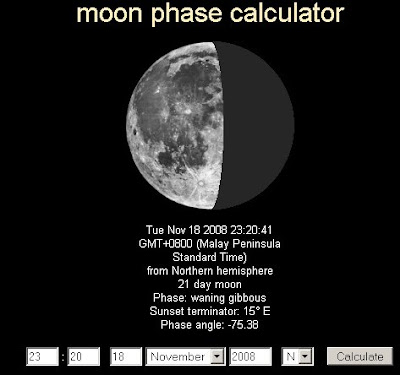
Moon Phase Tonight


I was quite surprised that there are people searching for the moon phases and hence I decided to take a screen shot and placed it here and the link.

- wong chee tat :)

Sunday, October 12, 2008

Moon Phase


Full Moon soon!
- wong chee tat :)