Sumatra quake: Tremors felt in Singapore; authorities urge calm
Police and the Singapore Civil Defence Force urge those in Singapore to remain calm after a 7.8-magnitude quake hit southwest Sumatra on Wednesday night. Tremors were subsequently felt in parts of Singapore.
Posted 02 Mar 2016 22:57 Updated 02 Mar 2016 23:20
SINGAPORE: Police have urged members of the public to remain calm after tremors were felt in Singapore, following a 7.8-magnitude earthquake that hit Indonesia on Wednesday night (Mar 2).
In an advisory, police said the Meteorological Services confirmed the earthquake hit southwest Sumatra - about 1,237km from Singapore - at about 8.49pm on Wednesday. Tremors were subsequently felt in parts of Singapore from 8.53pm. Both the Police and the Singapore Civil Defence Force received several calls from the public reporting these tremors, it said.
If members of the public are inside a building and feel tremors, police advise them to:
i) Take cover under a sturdy table or furniture
ii) Keep away from items made of glass or any hanging object
iii) Do not use the lift
iv) Do not use any naked light, in case there is a gas leak
Those out in the open should minimise their movement and stay away from buildings, street lights and utility wires, police added. After the vibrations have stopped, they should:
i) Stay away from any exposed electrical cables, hanging glass objects
ii) Report any gas leakage
iii) Help the injured, call SCDF if the injuries are significant
iv) Report any incidents or issues of law and order to Police
v) Tune in to the radio for updates, according to police
The Singapore Civil Defence Force similarly asked those in Singapore to not be alarmed, and posted information on what to do in the event of tremors.
TREMORS FELT IN BISHAN, EAST COAST, SENG KANG, ANG MO KIO
Residents in Singapore reported feeling tremors in areas including Bishan, Punggol, East Coast, Seng Kang and Ang Mo Kio. However, Singapore is unlikely to be affected by the earthquake, said the National Environment Agency.
A Katong resident, who only wanted to be identified as Ms Amanda, said she felt tremors from her 12th-floor apartment shortly after the quake struck, at about 9.05pm.
“I was lying down reading a book when suddenly I felt like the ground was moving side to side. I thought I was feeling tired, but my mum saw our lamps outside shaking, so we decided to evacuate,” she told Channel NewsAsia.
Amanda said there were about 15 residents gathered downstairs of her condominium. Her family of six stayed at the ground floor for about half an hour.
“We live quite high up, and we have two dining lamps which won’t shake if it’s just (strong) wind. It’s happened before during an earthquake as well,” said Ms Amanda of her family’s decision to self-evacuate from their apartment.
They eventually returned to their home at 9.30pm. “We just wanted to be safe first. We headed downstairs and saw other people, so that confirmed it,” she said.
A resident in Kembangan who lives in an apartment also reported feeling strong tremors from the quake. "I felt like I was swaying from left to right. On a scale of 1 to 5, I'll rate (the movement) at the 2.5 to 3," said Ms Jazryl Lee.
Indonesia, especially Aceh, was badly hit by the Indian Ocean tsunami in 2004. The country straddles the so-called "Pacific Ring of Fire", a highly seismically active zone, where different plates on the earth's crust meet and create a large number of earthquakes and volcanoes.
- CNA
- wong chee tat :)
Showing posts with label earth. Show all posts
Showing posts with label earth. Show all posts
Wednesday, March 2, 2016

Monday, June 17, 2013
Thursday, June 13, 2013
Wednesday, June 12, 2013
Sunday, March 24, 2013
Singapore's skyline plunges into darkness for "Earth Hour"
Singapore's skyline plunges into darkness for "Earth Hour"
By Sara Grosse | Posted: 23 March 2013 2132 hrs
SINGAPORE: In a massive display to show concern for the environment, it was lights out for Singapore's skyline.
Just after 8pm Saturday, several hotels, businesses and companies switched off their lights for Earth Hour. In all, more than 100 buildings around the city centre took part.
The event aims to unite the world in campaigning against climate change by the simple deed of just turning off the lights for one hour.
Some businesses have also pledged to go "beyond the hour".
For example, Marina Bay Sands has rallied team members to adopt environmental-friendly lifestyle changes.
And away from the city centre, it was also lights out in other parts of Singapore.
In Clementi, common lights at three blocks of flats were switched off for an hour from 8.30pm.
As part of the event, residents in the neighbourhood were also encouraged to turn off their lights at home.
Did you switch off your home lights for Earth Hour? Take part in our poll here
- CNA/ir
- wong chee tat :)
By Sara Grosse | Posted: 23 March 2013 2132 hrs
SINGAPORE: In a massive display to show concern for the environment, it was lights out for Singapore's skyline.
Just after 8pm Saturday, several hotels, businesses and companies switched off their lights for Earth Hour. In all, more than 100 buildings around the city centre took part.
The event aims to unite the world in campaigning against climate change by the simple deed of just turning off the lights for one hour.
Some businesses have also pledged to go "beyond the hour".
For example, Marina Bay Sands has rallied team members to adopt environmental-friendly lifestyle changes.
And away from the city centre, it was also lights out in other parts of Singapore.
In Clementi, common lights at three blocks of flats were switched off for an hour from 8.30pm.
As part of the event, residents in the neighbourhood were also encouraged to turn off their lights at home.
Did you switch off your home lights for Earth Hour? Take part in our poll here
- CNA/ir
- wong chee tat :)
Monday, March 21, 2011
Reports of sustained uptime in Japan continue
Reports of sustained uptime in Japan continue
No major data center outages reported following disaster
Published 18th March, 2011 by Yevgeniy Sverdlik
Many data center companies in Japan continued reporting throughout the week following a devastating earthquake and tsunami off Japan’s northeastern coast that their data centers continued normal operations. Ample fuel had been secured for many facilities’ backup generators to address rolling blackouts implemented by energy providers.
Jiro Fukuda of the Japan Data Center Council wrote in an email to DatacenterDynamics that there had not been any reports of major damage to data centers as of 17 March. “The Internet and other network services are being provided as usual,” he wrote.
“The discussion about the maintenance of long-term service continuance has already started [among] data center service providers,” Fukuda added.
JDDC is a data center industry consortium, consisting of representatives from the private sector, academia and the government.
Data center services provider Telehouse released a statement on 17 March, saying all 21 of its data centers in Japan were operational, including one in Sendai – the area most severely affected by the disaster.
The company said the data centers will stay operational throughout periodic three-hour rolling black-outs that have been implemented by Tohoku-Electric Power and Tokyo Electric Power.
“All facilities have a minimum 24-hour fuel supply plus regularly scheduled refueling (natural gas and/or diesel) and are expected to continue normal operations,” a Telehouse statement read.
HP and IBM, two large multinationals that act as both IT vendors and providers of data center services, also said their data centers continued normal operations.
HP CEO Leo Apotheker said during a press conference in San Francisco on 14 March that the company’s infrastructure in Japan “has not been really touched.”
IBM Japan spokesman Kazuhiro Kaneko wrote in an email to DatacenterDynamics on 15 March that “all IBM data centers have been working normally even just after the earthquake, and we keep delivering our services to the clients.”
Some services provided by the telecom Internet Initiative Japan were partly unavailable because of service disruptions experienced by some access-network carriers. IIJ said on 17 March that its own infrastructure continued operating as usual.
“IIJ's backbone network and service facilities are operating without disruption,” the company said.
IIJ services that were partially unavailable because of access-network carriers’ problems were Wide Area Network, Line management, FiberAccess, DSL and Mobile services.
Some of the company’s managed services, including security services, were affected by a “chaotic distribution channel”, delaying deliveries of network equipment.
Services affected by delivery disruptions include mobile, managed router, Internet-LAN, managed VPN Pro, managed firewall, IIJ DDoS and network intrusion detection, among others.
Delays in arrival of network-support staff could also play an effect on service availability, IIJ said.
- wong chee tat :)
No major data center outages reported following disaster
Published 18th March, 2011 by Yevgeniy Sverdlik
Many data center companies in Japan continued reporting throughout the week following a devastating earthquake and tsunami off Japan’s northeastern coast that their data centers continued normal operations. Ample fuel had been secured for many facilities’ backup generators to address rolling blackouts implemented by energy providers.
Jiro Fukuda of the Japan Data Center Council wrote in an email to DatacenterDynamics that there had not been any reports of major damage to data centers as of 17 March. “The Internet and other network services are being provided as usual,” he wrote.
“The discussion about the maintenance of long-term service continuance has already started [among] data center service providers,” Fukuda added.
JDDC is a data center industry consortium, consisting of representatives from the private sector, academia and the government.
Data center services provider Telehouse released a statement on 17 March, saying all 21 of its data centers in Japan were operational, including one in Sendai – the area most severely affected by the disaster.
The company said the data centers will stay operational throughout periodic three-hour rolling black-outs that have been implemented by Tohoku-Electric Power and Tokyo Electric Power.
“All facilities have a minimum 24-hour fuel supply plus regularly scheduled refueling (natural gas and/or diesel) and are expected to continue normal operations,” a Telehouse statement read.
HP and IBM, two large multinationals that act as both IT vendors and providers of data center services, also said their data centers continued normal operations.
HP CEO Leo Apotheker said during a press conference in San Francisco on 14 March that the company’s infrastructure in Japan “has not been really touched.”
IBM Japan spokesman Kazuhiro Kaneko wrote in an email to DatacenterDynamics on 15 March that “all IBM data centers have been working normally even just after the earthquake, and we keep delivering our services to the clients.”
Some services provided by the telecom Internet Initiative Japan were partly unavailable because of service disruptions experienced by some access-network carriers. IIJ said on 17 March that its own infrastructure continued operating as usual.
“IIJ's backbone network and service facilities are operating without disruption,” the company said.
IIJ services that were partially unavailable because of access-network carriers’ problems were Wide Area Network, Line management, FiberAccess, DSL and Mobile services.
Some of the company’s managed services, including security services, were affected by a “chaotic distribution channel”, delaying deliveries of network equipment.
Services affected by delivery disruptions include mobile, managed router, Internet-LAN, managed VPN Pro, managed firewall, IIJ DDoS and network intrusion detection, among others.
Delays in arrival of network-support staff could also play an effect on service availability, IIJ said.
- wong chee tat :)
Wednesday, March 16, 2011
Japan Quake May Have Slightly Shortened Earth Days, Moved Axis, Theoretical Calculations Suggest
Japan Quake May Have Slightly Shortened Earth Days, Moved Axis, Theoretical Calculations Suggest
ScienceDaily (Mar. 15, 2011) — The magnitude 9.0 earthquake that struck Japan March 11, 2011 may have slightly shortened the length of each Earth day and shifted its axis.
Using a United States Geological Survey estimate for how the fault responsible for the earthquake slipped, research scientist Richard Gross of NASA's Jet Propulsion Laboratory, Pasadena, Calif., applied a complex model to perform a preliminary theoretical calculation of how the Japan earthquake -- the fifth largest since 1900 -- affected Earth's rotation. His calculations indicate that by changing the distribution of Earth's mass, the Japanese earthquake should have caused Earth to rotate a bit faster, shortening the length of the day by about 1.8 microseconds (a microsecond is one millionth of a second).
The calculations also show the Japan quake should have shifted the position of Earth's figure axis (the axis about which Earth's mass is balanced) by about 17 centimeters (6.5 inches), towards 133 degrees east longitude. Earth's figure axis should not be confused with its north-south axis; they are offset by about 10 meters (about 33 feet). This shift in Earth's figure axis will cause Earth to wobble a bit differently as it rotates, but it will not cause a shift of Earth's axis in space -- only external forces such as the gravitational attraction of the sun, moon and planets can do that.
Both calculations will likely change as data on the quake are further refined.
In comparison, following last year's magnitude 8.8 earthquake in Chile, Gross estimated the Chile quake should have shortened the length of day by about 1.26 microseconds and shifted Earth's figure axis by about 8 centimeters (3 inches). A similar calculation performed after the 2004 magnitude 9.1 Sumatran earthquake revealed it should have shortened the length of day by 6.8 microseconds and shifted Earth's figure axis by about 7 centimeters, or 2.76 inches. How an individual earthquake affects Earth's rotation depends on its size (magnitude), location and the details of how the fault slipped.
Gross said that, in theory, anything that redistributes Earth's mass will change Earth's rotation.
"Earth's rotation changes all the time as a result of not only earthquakes, but also the much larger effects of changes in atmospheric winds and oceanic currents," he said. "Over the course of a year, the length of the day increases and decreases by about a millisecond, or about 550 times larger than the change caused by the Japanese earthquake. The position of Earth's figure axis also changes all the time, by about 1 meter (3.3 feet) over the course of a year, or about six times more than the change that should have been caused by the Japan quake."
Gross said that while we can measure the effects of the atmosphere and ocean on Earth's rotation, the effects of earthquakes, at least up until now, have been too small to measure. The computed change in the length of day caused by earthquakes is much smaller than the accuracy with which scientists can currently measure changes in the length of the day. However, since the position of the figure axis can be measured to an accuracy of about 5 centimeters (2 inches), the estimated 17-centimeter shift in the figure axis from the Japan quake may actually be large enough to observe if scientists can adequately remove the larger effects of the atmosphere and ocean from the Earth rotation measurements. He and other scientists will be investigating this as more data become available.
Gross said the changes in Earth's rotation and figure axis caused by earthquakes should not have any impacts on our daily lives. "These changes in Earth's rotation are perfectly natural and happen all the time," he said. "People shouldn't worry about them."
Story Source:
The above story is reprinted (with editorial adaptations by ScienceDaily staff) from materials provided by NASA/Jet Propulsion Laboratory.
- wong chee tat :)
ScienceDaily (Mar. 15, 2011) — The magnitude 9.0 earthquake that struck Japan March 11, 2011 may have slightly shortened the length of each Earth day and shifted its axis.
Using a United States Geological Survey estimate for how the fault responsible for the earthquake slipped, research scientist Richard Gross of NASA's Jet Propulsion Laboratory, Pasadena, Calif., applied a complex model to perform a preliminary theoretical calculation of how the Japan earthquake -- the fifth largest since 1900 -- affected Earth's rotation. His calculations indicate that by changing the distribution of Earth's mass, the Japanese earthquake should have caused Earth to rotate a bit faster, shortening the length of the day by about 1.8 microseconds (a microsecond is one millionth of a second).
The calculations also show the Japan quake should have shifted the position of Earth's figure axis (the axis about which Earth's mass is balanced) by about 17 centimeters (6.5 inches), towards 133 degrees east longitude. Earth's figure axis should not be confused with its north-south axis; they are offset by about 10 meters (about 33 feet). This shift in Earth's figure axis will cause Earth to wobble a bit differently as it rotates, but it will not cause a shift of Earth's axis in space -- only external forces such as the gravitational attraction of the sun, moon and planets can do that.
Both calculations will likely change as data on the quake are further refined.
In comparison, following last year's magnitude 8.8 earthquake in Chile, Gross estimated the Chile quake should have shortened the length of day by about 1.26 microseconds and shifted Earth's figure axis by about 8 centimeters (3 inches). A similar calculation performed after the 2004 magnitude 9.1 Sumatran earthquake revealed it should have shortened the length of day by 6.8 microseconds and shifted Earth's figure axis by about 7 centimeters, or 2.76 inches. How an individual earthquake affects Earth's rotation depends on its size (magnitude), location and the details of how the fault slipped.
Gross said that, in theory, anything that redistributes Earth's mass will change Earth's rotation.
"Earth's rotation changes all the time as a result of not only earthquakes, but also the much larger effects of changes in atmospheric winds and oceanic currents," he said. "Over the course of a year, the length of the day increases and decreases by about a millisecond, or about 550 times larger than the change caused by the Japanese earthquake. The position of Earth's figure axis also changes all the time, by about 1 meter (3.3 feet) over the course of a year, or about six times more than the change that should have been caused by the Japan quake."
Gross said that while we can measure the effects of the atmosphere and ocean on Earth's rotation, the effects of earthquakes, at least up until now, have been too small to measure. The computed change in the length of day caused by earthquakes is much smaller than the accuracy with which scientists can currently measure changes in the length of the day. However, since the position of the figure axis can be measured to an accuracy of about 5 centimeters (2 inches), the estimated 17-centimeter shift in the figure axis from the Japan quake may actually be large enough to observe if scientists can adequately remove the larger effects of the atmosphere and ocean from the Earth rotation measurements. He and other scientists will be investigating this as more data become available.
Gross said the changes in Earth's rotation and figure axis caused by earthquakes should not have any impacts on our daily lives. "These changes in Earth's rotation are perfectly natural and happen all the time," he said. "People shouldn't worry about them."
Story Source:
The above story is reprinted (with editorial adaptations by ScienceDaily staff) from materials provided by NASA/Jet Propulsion Laboratory.
- wong chee tat :)
Thursday, July 23, 2009
370 solar eclipse enthusiasts in Singapore stay indoors due to rain
370 solar eclipse enthusiasts in Singapore stay indoors due to rain
By Jessica Yeo, Channel NewsAsia
SINGAPORE : 370 Singaporeans gathered at the Singapore Science Centre to catch the solar eclipse on Wednesday morning, but they ended up staying indoors because of the rain which resulted in poor visibility.
10 per cent of the eclipse could have been seen in Singapore between 8:41am and 9:43am, with its optimum position at 9:11am.
The next eclipse is expected on 15 January 2010, and Singaporeans will be able to catch 30 per cent of it.
But Singapore will have to wait until 2019 for the annular eclipse if residents want to see the moon's shadow totally cast on the sun.
"The eclipse is caused by the moon casting a shadow on the Earth and this time round, the path of the shadow passes through the densely populated areas in China. Singapore happens to be literally at the fringe of the activity," said Dr Chew Tuan Chiong, CEO of Singapore Science Centre.
- CNA /ls
- wong chee tat :)
By Jessica Yeo, Channel NewsAsia
SINGAPORE : 370 Singaporeans gathered at the Singapore Science Centre to catch the solar eclipse on Wednesday morning, but they ended up staying indoors because of the rain which resulted in poor visibility.
10 per cent of the eclipse could have been seen in Singapore between 8:41am and 9:43am, with its optimum position at 9:11am.
The next eclipse is expected on 15 January 2010, and Singaporeans will be able to catch 30 per cent of it.
But Singapore will have to wait until 2019 for the annular eclipse if residents want to see the moon's shadow totally cast on the sun.
"The eclipse is caused by the moon casting a shadow on the Earth and this time round, the path of the shadow passes through the densely populated areas in China. Singapore happens to be literally at the fringe of the activity," said Dr Chew Tuan Chiong, CEO of Singapore Science Centre.
- CNA /ls
- wong chee tat :)
Wednesday, July 22, 2009
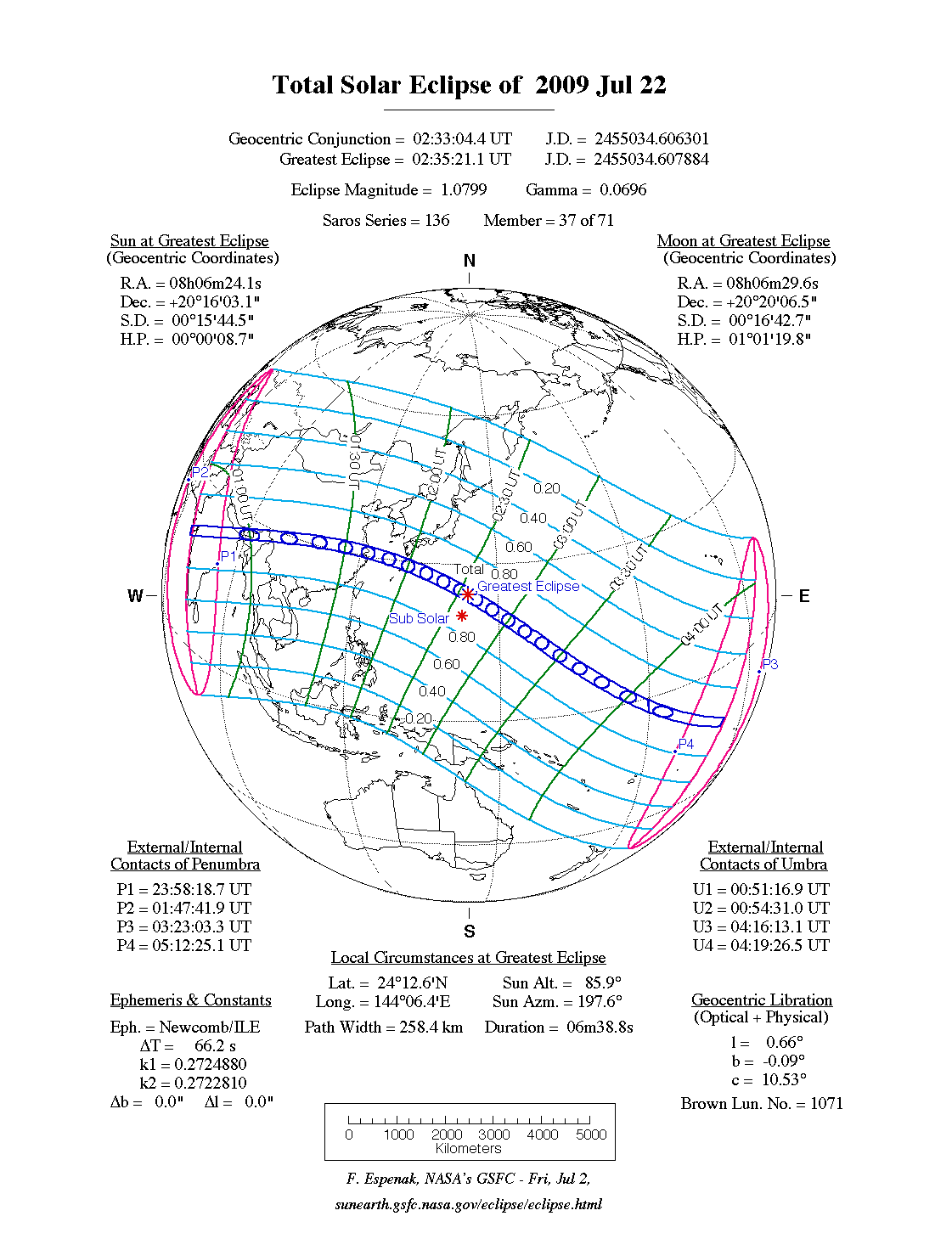
Solar eclipse 2009: Totality crosses eastern Asia

Unfortunately, it is raining quite heavily from 8 am till 9 plus in Singapore today. So it is not possible to view the eclipse.
- wong chee tat :)
Tuesday, July 21, 2009
Singapore to experience minimal effects of upcoming solar eclipse
Singapore to experience minimal effects of upcoming solar eclipse
S’pore to experience minimal effects of the upcoming eclipse
SINGAPORE: Come Wednesday, China, India and Japan will be seeing its longest total solar eclipse in almost 500 years.
But Singapore will have to wait a little longer to experience the full eclipse.
Scientists said Singapore will only experience a partial solar eclipse between 8.40am and 9.40am.
They added that unlike other countries there will be minimal changes to temperature and visibility.
The Singapore Science Centre will be providing special equipment for members of the public to view the eclipse.
It will also have talks about the astronomical phenomenon.
- CNA/vm
- wong chee tat :)
S’pore to experience minimal effects of the upcoming eclipse
SINGAPORE: Come Wednesday, China, India and Japan will be seeing its longest total solar eclipse in almost 500 years.
But Singapore will have to wait a little longer to experience the full eclipse.
Scientists said Singapore will only experience a partial solar eclipse between 8.40am and 9.40am.
They added that unlike other countries there will be minimal changes to temperature and visibility.
The Singapore Science Centre will be providing special equipment for members of the public to view the eclipse.
It will also have talks about the astronomical phenomenon.
- CNA/vm
- wong chee tat :)
Sunday, July 12, 2009
Friday, June 12, 2009
Swine Flu Update: WHO Declares Pandemic In Response To Ongoing Global Spread Of Novel Influenza A (H1N1) Virus
Swine Flu Update: WHO Declares Pandemic In Response To Ongoing Global Spread Of Novel Influenza A (H1N1) Virus
ScienceDaily (June 12, 2009) — On June 11, 2009, the World Health Organization (WHO) raised the worldwide pandemic alert level to Phase 6 in response to the ongoing global spread of the novel influenza A (H1N1) virus, which causes swine flu. A Phase 6 designation indicates that a global pandemic is underway.
More than 70 countries are now reporting cases of human infection with novel H1N1 flu. This number has been increasing over the past few weeks, but many of the cases reportedly had links to travel or were localized outbreaks without community spread. The WHO designation of a pandemic alert Phase 6 reflects the fact that there are now ongoing community level outbreaks in multiple parts of world.
WHO’s decision to raise the pandemic alert level to Phase 6 is a reflection of the spread of the virus, not the severity of illness caused by the virus. It’s uncertain at this time how serious or severe this novel H1N1 pandemic will be in terms of how many people infected will develop serious complications or die from novel H1N1 infection. Experience with this virus so far is limited and influenza is unpredictable. However, because novel H1N1 is a new virus, many people may have little or no immunity against it, and illness may be more severe and widespread as a result. In addition, currently there is no vaccine to protect against novel H1N1 virus.
In the United States, most people who have become ill with the newly declared pandemic virus have recovered without requiring medical treatment, however, CDC anticipates that there will be more cases, more hospitalizations and more deaths associated with this pandemic in the coming days and weeks. In addition, this virus could cause significant illness with associated hospitalizations and deaths in the fall and winter during the U.S. influenza season.
Background
Novel influenza A (H1N1) is a new flu virus of swine origin that first caused illness in Mexico and the United States in March and April, 2009. It’s thought that novel influenza A (H1N1) flu spreads in the same way that regular seasonal influenza viruses spread, mainly through the coughs and sneezes of people who are sick with the virus, but it may also be spread by touching infected objects and then touching your nose or mouth. Novel H1N1 infection has been reported to cause a wide range of flu-like symptoms, including fever, cough, sore throat, body aches, headache, chills and fatigue. In addition, many people also have reported nausea, vomiting and/or diarrhea.
The first novel H1N1 patient in the United States was confirmed by laboratory testing at CDC on April 15, 2009. The second patient was confirmed on April 17, 2009. It was quickly determined that the virus was spreading from person-to-person. On April 22, CDC activated its Emergency Operations Center to better coordinate the public health response. On April 26, 2009, the United States Government declared a public health emergency and has been actively and aggressively implementing the nation’s pandemic response plan.
Since the outbreak was first detected, an increasing number of U.S. states have reported cases of novel H1N1 influenza with associated hospitalizations and deaths. By June 3, 2009, all 50 states in the United States and the District of Columbia and Puerto Rico were reporting cases of novel H1N1 infection. While nationwide U.S. influenza surveillance systems indicate that overall influenza activity is decreasing in the country at this time, novel H1N1 outbreaks are ongoing in parts of the U.S., in some cases with intense activity.
CDC is continuing to watch the situation carefully, to support the public health response and to gather information about this virus and its characteristics. The Southern Hemisphere is just beginning its influenza season and the experience there may provide valuable clues about what may occur in the Northern Hemisphere this fall and winter.
CDC Response
CDC continues to take aggressive action to respond to the outbreak. CDC’s response goals are to reduce the spread and severity of illness, and to provide information to help health care providers, public health officials and the public address the challenges posed by this new public health threat.
CDC is issuing updated interim guidance in response to the rapidly evolving situation (see: http://www.cdc.gov/h1n1flu/recommendations.htm).
Clinician Guidance
CDC has issued interim guidance for clinicians on identifying and caring for patients with novel H1N1 (see: http://www.cdc.gov/h1n1flu/identifyingpatients.htm), in addition to providing interim guidance on the use of antiviral drugs (see: http://www.cdc.gov/h1n1flu/recommendations.htm). Influenza antiviral drugs are prescription medicines (pills, liquid or an inhaled powder) with activity against influenza viruses, including novel influenza H1N1 viruses. The priority use for influenza antiviral drugs during this outbreak is to treat people hospitalized with influenza illness, and to treat people at increased risk of severe illness, including pregnant women, young children, and people with chronic health conditions like asthma, diabetes and other metabolic diseases, heart or lung disease, kidney disease, weakened immune systems, and persons with neurologic or neuromuscular disease.
Public Guidance
CDC has provided guidance for the public on what to do if they become sick with flu-like symptoms, including infection with novel H1N1 (see: http://www.cdc.gov/h1n1flu/sick.htm). CDC also has issued instructions on taking care of a sick person at home (see: http://www.cdc.gov/h1n1flu/guidance_homecare.htm) and the use of facemasks and respirators to reduce novel influenza A (H1n1) transmission (see: http://www.cdc.gov/h1n1flu/masks.htm). Everyone should take everyday preventive actions to stop the spread of germs, including frequent hand washing and people who are sick should stay home and avoid contact with others in order to limit further spread of the disease.
Testing
CDC has developed a PCR diagnostic test kit to detect this novel H1N1 virus and has now distributed test kits to all states in the U.S. and the District of Columbia and Puerto Rico. The test kits are being shipped internationally as well. This will allow states and other countries to test for this new virus.
Vaccine
Vaccines are a very important part of a response to pandemic influenza and the U.S. Government is aggressively taking early steps in the process to manufacture a novel H1N1 vaccine, working closely with manufacturers. CDC has isolated the new H1N1 virus, made a candidate vaccine virus that can be used to create vaccine, and has provided this virus to industry so they can begin scaling up for production of a vaccine, if necessary. Making vaccine is a long multi-step process requiring several months to complete.
Stockpile Deployment
CDC has deployed 25 percent of the supplies in the Strategic National Stockpile (SNS) to all states in the continental United States and U.S. territories. This included antiviral drugs, personal protective equipment, and respiratory protection devices. The influenza A (H1N1) virus is susceptible to the prescription antiviral drugs oseltamivir and zanamivir. These supplies and medicines will help states and U.S. territories respond to novel H1N1 virus.
Surveillance
Novel influenza A (H1N1) activity is now being detected through CDC’s routine influenza surveillance systems and reported weekly in FluView. CDC tracks U.S. influenza activity through multiple systems across five categories. While our influenza surveillance systems indicate that overall influenza activity is decreasing in the United States, novel H1N1 outbreaks are ongoing in different parts of the U.S., in some cases with intense influenza-like activity. Most of the influenza viruses being detected now are novel H1N1 viruses.
Shared Responsibility
Individuals have an important role in protecting themselves and their families.
* Stay informed. Health officials will provide additional information as it becomes available.
* Everyone should take these everyday steps to protect your health and lessen the spread of this new virus:
o Cover your nose and mouth with a tissue when you cough or sneeze. Throw the tissue in the trash after you use it.
o Wash your hands often with soap and water, especially after you cough or sneeze. Alcohol-based hand cleaners are also effective.
o Avoid touching your eyes, nose or mouth. Germs spread this way.
o Try to avoid close contact with sick people.
o If you are sick with a flu-like illness, stay home for 7 days after your symptoms begin or until you have been symptom-free for 24 hours, whichever is longer. This is to keep from infecting others and spreading the virus further.
o Follow public health advice regarding school closures, avoiding crowds and other social
distancing measures.
- wong chee tat :)
Saturday, March 28, 2009
S'pore observes Earth Hour, many buildings switch off lights for an hour
S'pore observes Earth Hour, many buildings switch off lights for an hour
By Timothy Ouyang, Channel NewsAsia
SINGAPORE : Thousands of people across Singapore observed Earth Hour on Saturday, as individuals at home and organisations switched off their lights for an hour.
Many parts of Singapore were plunged into darkness, as the lights went off at 8.30pm Singapore time, and remained switched off until 9.30pm.
Earth Hour is a global initiative by the World Wide Fund for Nature to raise awareness of climate change. It is the second year that Earth Hour is being observed in Singapore.
Various hotels across the Marina Bay area switched off their lights at 8.30pm sharp.
Even the Singapore Flyer took part in observing Earth Hour this year.
The Fullerton Hotel dimmed its lights at 8.30pm sharp, while over at Raffles Place, the colourful lights outlining the Maybank building were switched off as well.
Downtown at Orchard Road, shopping malls also joined in to play their part in raising awareness of global warming and climate change.
More than 10,000 people pledged to take part in Earth Hour this year, and more than 450 businesses also said they would switch off their lights.
Earlier, on Saturday evening, hundreds of people gathered at the Esplanade Park for a picnic. Some of them told Channel NewsAsia that they were there to show support for Earth Hour, while others just wanted to have some fun.
Singapore is of one of the many countries in Asia that have joined the world in switching off its lights for 60 minutes.
Altogether, some 83 countries are expected to observe Earth Hour this year.
- CNA/ms
- wong chee tat :)
By Timothy Ouyang, Channel NewsAsia
SINGAPORE : Thousands of people across Singapore observed Earth Hour on Saturday, as individuals at home and organisations switched off their lights for an hour.
Many parts of Singapore were plunged into darkness, as the lights went off at 8.30pm Singapore time, and remained switched off until 9.30pm.
Earth Hour is a global initiative by the World Wide Fund for Nature to raise awareness of climate change. It is the second year that Earth Hour is being observed in Singapore.
Various hotels across the Marina Bay area switched off their lights at 8.30pm sharp.
Even the Singapore Flyer took part in observing Earth Hour this year.
The Fullerton Hotel dimmed its lights at 8.30pm sharp, while over at Raffles Place, the colourful lights outlining the Maybank building were switched off as well.
Downtown at Orchard Road, shopping malls also joined in to play their part in raising awareness of global warming and climate change.
More than 10,000 people pledged to take part in Earth Hour this year, and more than 450 businesses also said they would switch off their lights.
Earlier, on Saturday evening, hundreds of people gathered at the Esplanade Park for a picnic. Some of them told Channel NewsAsia that they were there to show support for Earth Hour, while others just wanted to have some fun.
Singapore is of one of the many countries in Asia that have joined the world in switching off its lights for 60 minutes.
Altogether, some 83 countries are expected to observe Earth Hour this year.
- CNA/ms
- wong chee tat :)
Sydney first major city to mark Earth Hour 2009
Sydney first major city to mark Earth Hour 2009
March 28th, 2009 By KRISTEN GELINEAU , Associated Press Writer About a hundred participants in an event to mark Earth Hour celebrate with a group photo after the event in which they freeze their movement for a few minutes at a shopping mall in Beijing, China, Saturday, March 28 , 2009. The lights are going down from the Great Pyramids to the Acropolis, the Eiffel Tower to Sears Tower, as more than 2,800 municipalities in 84 countries plan Saturday to mark the second worldwide Earth Hour. (AP Photo/Ng Han Guan)
(AP) -- The floodlit cream shells of the famed Opera House dimmed Saturday as Sydney became the world's first major city to plunge itself into darkness for the second worldwide Earth Hour, a global campaign to highlight the threat of climate change.
From the Great Pyramids to the Acropolis, the London Eye to the Las Vegas strip, nearly 4,000 cities and towns in 88 countries planned to join in the World Wildlife Fund-sponsored event, a time zone-by-time zone plan to dim nonessential lights between 8:30 p.m. and 9:30 p.m.
Involvement in the effort has exploded since last year's Earth Hour, which drew participation from 400 cities after Sydney held a solo event in 2007. Interest has spiked ahead of planned negotiations on a new global warming treaty in Copenhagen, Denmark, this December. The last global accord, the Kyoto Protocol, is set to expire in 2012.
Despite the boost in interest from the Copenhagen negotiations, organizers initially worried enthusiasm for this year's event would wane with the world's attention focused largely on the global economic crisis, Earth Hour executive director Andy Ridley told The Associated Press. Strangely enough, he said, it's seemed to have the opposite effect.
"Earth Hour has always been a positive campaign; it's always around street parties, not street protests, it's the idea of hope not despair. And I think that's something that's been incredibly important this year because there is so much despair around," he said. "On the other side of it, there's savings in cutting your power usage and being more sustainable and more efficient."In Australia, people attended candlelit speed-dating events and gathered at outdoor concerts as the hour of darkness rolled through the country. Sydney's glittering harbor was bathed in shadows as lights dimmed on the steel arch of the city's iconic Harbour Bridge and the nearby Opera House.
Earlier Saturday, the Chatham Islands, a group of small islands about 500 miles (800 kilometers) east of New Zealand, officially kicked off Earth Hour by switching off its diesel generators. Soon after, the lights of Auckland's Sky Tower, the tallest man-made structure in New Zealand, blinked off.
Forty-four New Zealand towns and cities participated in the event, and more than 60,000 people showed up for an Earth Hour-themed hot air ballooning festival in the city of Hamilton.
At Scott Base in Antarctica, New Zealand's 26-member winter team resorted to minimum safety lighting and switched off appliances and computers.
China was participating in the campaign for the first time, with Beijing turning off the lights at its Bird's Nest Stadium and Water Cube, the most prominent venues for the Olympics, according to WWF. Shanghai was also cutting lights in all government buildings and other structures on its waterfront, while Hong Kong, Baoding, Changchun, Dalian, Nanjing and Guangzhou were also participating, WWF said.
However, the official WWF Earth Hour Web site appeared to be blocked in Beijing, Shanghai and Tianjin on Saturday afternoon. While China rarely gives reasons for blocking Web sites, the campaign coincided with the 50th anniversary of the suppression of an uprising in Tibet that forced the Dalai Lama to go into exile.
In Hong Kong, the government planned to suspend its nightly "Symphony of Lights," which beams lasers and lights into the sky from 44 buildings on the city's famed Victoria Harbor. Landmarks along the harbor also were to switch off nonessential lights for an hour.
Later Saturday, Thailand's Prime Minister Abhisit Vejjajiva planned to press a button to turn off the lights at Khao San Road, a famous haven for budget travelers in Bangkok that is packed with bars and outdoor cafes.
Lights were to go down at the Grand Palace and other riverside monuments, and businesses along some of the Thai capital's busiest boulevards were also asked to participate, the Bangkok Metropolitan Administration said in a statement.
The capital hoped to reduce electricity consumption in the city of more than 8 million people by at least 30 percent - or 1,400 megawatts - during the event. Earth Hour organizers say there's no uniform way to measure how much energy is saved worldwide.
Earth Hour 2009 has garnered support from global corporations, nonprofit groups, schools, scientists and celebrities - including Oscar-winning actress Cate Blanchett and retired Cape Town Archbishop Desmond Tutu.
McDonald's Corp. planned to dim its arches at 500 locations around the Midwest in the United States. The Marriott, Ritz-Carlton and Fairmont hotel chains and Coca-Cola Co. also planned to participate.
- wong chee tat :)
Earth Hour

Did you do your part ?
I played a small part by temporarily off my systems for an hour!
Earth Hour
- wong chee tat :)
Tuesday, January 27, 2009
Update 2: Annular Solar Eclipse
Here are some of the pictures from various sources that captured the solar eclipse on Jan 26th 2009.


Indonesians among the few to witness solar eclipse

S’poreans gather at Science Centre, mosque to watch solar eclipse
Channel NewsAsia
Channel NewsAsia - Tuesday, January 27
SINGAPORE : It was the first solar eclipse of the year, and many said it was the clearest seen in 10 years.
More than 6,400 people were at the Singapore Science Centre’s Observatory Centre on Monday to watch the rare phenomenon unfold at about 4.30pm.
However, before the maximum eclipse could be seen, visibility started to dip at about 5.40pm.
Another group of Singaporeans was at the Al—Firdaus Mosque to witness the same natural phenomenon.
They also took part in activities which included calculating and predicting the next solar eclipse.
Experts said the next solar eclipse that can be seen in Singapore will likely be on July 22 this year.
However, it will be not be as vivid as the one on Monday, where observers could see the moon’s shadow covering almost 80 per cent of the sun’s surface.
— CNA/ms
- http://shadowandsubstance.com/
- http://www.eclipse.org.uk/eclipse/0132009/
-http://news.yahoo.com/nphotos/Solar-Eclipse/ss/events/sc/012609solareclipse;_ylt=Al4YpLcEiNY22j_Vd40OBTH9xg8F;_ylu=X3oDMTFmMGM3MmJyBHBvcwMxNwRzZWMDeW5fcl8zc2xvdF9zbGlkZXNob3cEc2xrA3NsaS1ldi1saW5r
- wong chee tat :)


Indonesians among the few to witness solar eclipse
By ZAKKI HAKIM,Associated Press Writer AP - Tuesday, January 27
ANYER, Indonesia - Indonesians were among the few worldwide to witness an eclipse of the sun Monday, but even there the view was hampered in most places by cloudy skies.
Dozens gathered in the western coastal town of Anyer as the moon passed across the sun's path at 4:40 p.m., covering 92 percent of the sun's diameter and leaving a white, flaming ring of fire that lasted about four minutes.
"I'm old, but I still think this is magical," said Roanna Makmur, 66, who drove several hours with eight friends to witness the sight, known as an annular eclipse, because it does not completely black out the sun.
"I can't help but feel the greatness of God," she said, as other onlookers cheered. "Anyone who passed up this opportunity, really missed out."
Annular eclipses, which are considered far less important to astronomers than total eclipses of the sun, occur about 66 times a century and can only be viewed by people in the narrow band along its path.
A relatively small number of people were in the best places to view Monday's eclipse, said Jay Pasachoff, professor of astronomy at Williams College in Williamstown, Massachusetts, and chair of the International Astronomical Union's Working Group on Eclipses.
Aside from several regions in Indonesia, the world's largest archipelago, only villagers on a tiny South Pacific island group known as the Cocos, administered by Australia, were to have been able to see the ring-shaped corona, he wrote in a statement.
A partial eclipse _ with coverage ranging from 1 percent to 84 percent of the sun's diameter _ was to be visible in the southern third of Africa, in southeastern India, and southeast Asia, as well as the western part of Australia.
The last total eclipse of the sun was Aug. 1, 2008, and was visible in Canada, across northern Greenland, the Arctic, central Russia, Mongolia and China.
The next total eclipse will be July 22, 2009, and will be visible in India, Nepal, Bangladesh, Bhutan, Myanmar, China and some Japanese islands.
___
On the Net:
Path details: http://eclipse.gsfc.nasa.gov/OH/OHfigures/OH2009-Fig01.pdf
S’poreans gather at Science Centre, mosque to watch solar eclipse
Channel NewsAsia
Channel NewsAsia - Tuesday, January 27
SINGAPORE : It was the first solar eclipse of the year, and many said it was the clearest seen in 10 years.
More than 6,400 people were at the Singapore Science Centre’s Observatory Centre on Monday to watch the rare phenomenon unfold at about 4.30pm.
However, before the maximum eclipse could be seen, visibility started to dip at about 5.40pm.
Another group of Singaporeans was at the Al—Firdaus Mosque to witness the same natural phenomenon.
They also took part in activities which included calculating and predicting the next solar eclipse.
Experts said the next solar eclipse that can be seen in Singapore will likely be on July 22 this year.
However, it will be not be as vivid as the one on Monday, where observers could see the moon’s shadow covering almost 80 per cent of the sun’s surface.
— CNA/ms
- http://shadowandsubstance.com/
- http://www.eclipse.org.uk/eclipse/0132009/
-http://news.yahoo.com/nphotos/Solar-Eclipse/ss/events/sc/012609solareclipse;_ylt=Al4YpLcEiNY22j_Vd40OBTH9xg8F;_ylu=X3oDMTFmMGM3MmJyBHBvcwMxNwRzZWMDeW5fcl8zc2xvdF9zbGlkZXNob3cEc2xrA3NsaS1ldi1saW5r
- wong chee tat :)
Saturday, January 17, 2009
BURN-E
From wiki:
The story begins with WALL-E running his hand through the rings of Saturn while holding on to the side of EVE's spaceship. One of the rock particles that swirls away begins to increase in velocity and size once it moves up against the atmosphere of Mars, becoming a meteorite that destroys a small lamp outside the Axiom. A repair robot named BURN-E is dispatched by SUPPLY-R, a storage robot that dispenses spare lamp spires, to replace it. Before he can secure the lamp, EVE's ship begins to enter the Axiom's docking bay. Still clinging onto the side of the ship, WALL-E waves to BURN-E, who waves back, distracting him while the loose lamp floats off into space.
Obtaining another spare from SUPPLY-R, BURN-E begins to weld the lamp down. Meanwhile, inside the Axiom, WALL-E and EVE witness the security robot GO-4 place the plant from Earth into an escape pod set to self-destruct, launching it with WALL-E inside and EVE giving chase. The pod explodes a few seconds later and BURN-E turns around in surprise, accidentally slicing off the lamp with his blowtorch. Annoyed, SUPPLY-R gives BURN-E the last spare lamp, which BURN-E finally manages to install successfully. At this time, WALL-E, who survived the pod explosion, is dancing in space with EVE. The two enter the ship through the only available entrance near BURN-E, flying inside and accidentally locking him out.
After BURN-E sits hopelessly outside for some time, WALL-E and EVE are about to be jettisoned into space through a garbage airlock. BURN-E sees the airlock open and tries to enter the ship, but as soon as he reaches it, a WALL-A unit pushes a button that slams the airlock shut in front of BURN-E. BURN-E gives up all hope and begins to doodle with his blowtorch when it dawns on him that he can cut a hole in the door with it. He does so and returns to SUPPLY-R to turn on the lamp. Before he can, the Captain of the Axiom and Auto get into a fight, causing the ship to tilt off its axis, throwing BURN-E outside again. The Captain deactivates Auto and realigns the ship, which then blasts into hyperspace at full momentum, pinning BURN-E to the hull.
The Axiom lands on Earth, and BURN-E goes back inside to find the ship has been completely deserted. BURN-E's search leads him into one of the ship's escape pods, where he sees SUPPLY-R out the window. BURN-E waves to him from inside the pod, accidentally launching it and crashing to the ground below near SUPPLY-R. BURN-E flings the hatch on the pod off and finally turns on the lamp, which is then destroyed by the flying hatch. BURN-E collapses in defeat. After the credits, SUPPLY-R attempts to console the inconsolable BURN-E by patting him on the head, saying, "There, there."
The story begins with WALL-E running his hand through the rings of Saturn while holding on to the side of EVE's spaceship. One of the rock particles that swirls away begins to increase in velocity and size once it moves up against the atmosphere of Mars, becoming a meteorite that destroys a small lamp outside the Axiom. A repair robot named BURN-E is dispatched by SUPPLY-R, a storage robot that dispenses spare lamp spires, to replace it. Before he can secure the lamp, EVE's ship begins to enter the Axiom's docking bay. Still clinging onto the side of the ship, WALL-E waves to BURN-E, who waves back, distracting him while the loose lamp floats off into space.
Obtaining another spare from SUPPLY-R, BURN-E begins to weld the lamp down. Meanwhile, inside the Axiom, WALL-E and EVE witness the security robot GO-4 place the plant from Earth into an escape pod set to self-destruct, launching it with WALL-E inside and EVE giving chase. The pod explodes a few seconds later and BURN-E turns around in surprise, accidentally slicing off the lamp with his blowtorch. Annoyed, SUPPLY-R gives BURN-E the last spare lamp, which BURN-E finally manages to install successfully. At this time, WALL-E, who survived the pod explosion, is dancing in space with EVE. The two enter the ship through the only available entrance near BURN-E, flying inside and accidentally locking him out.
After BURN-E sits hopelessly outside for some time, WALL-E and EVE are about to be jettisoned into space through a garbage airlock. BURN-E sees the airlock open and tries to enter the ship, but as soon as he reaches it, a WALL-A unit pushes a button that slams the airlock shut in front of BURN-E. BURN-E gives up all hope and begins to doodle with his blowtorch when it dawns on him that he can cut a hole in the door with it. He does so and returns to SUPPLY-R to turn on the lamp. Before he can, the Captain of the Axiom and Auto get into a fight, causing the ship to tilt off its axis, throwing BURN-E outside again. The Captain deactivates Auto and realigns the ship, which then blasts into hyperspace at full momentum, pinning BURN-E to the hull.
The Axiom lands on Earth, and BURN-E goes back inside to find the ship has been completely deserted. BURN-E's search leads him into one of the ship's escape pods, where he sees SUPPLY-R out the window. BURN-E waves to him from inside the pod, accidentally launching it and crashing to the ground below near SUPPLY-R. BURN-E flings the hatch on the pod off and finally turns on the lamp, which is then destroyed by the flying hatch. BURN-E collapses in defeat. After the credits, SUPPLY-R attempts to console the inconsolable BURN-E by patting him on the head, saying, "There, there."
- wong chee tat :)
Subscribe to:
Posts (Atom)