Showing posts with label Solar Eclipse. Show all posts

Sunday, August 21, 2016

Friday, November 16, 2012

澳洲北部出现壮观日全食


星期三(14日)的清晨,澳洲北部出现了罕见的日全食。这个自然奇观让人叹为观止。


澳洲北部出现壮观日全食 (© Photo by Ian Hitchcock/Getty Images)
Next
Previous
Photo by Ian Hitchcock/Getty ImagesShow Thumbnails
Previous1 of 11Next
今天清晨,澳洲北部的居民和好几千名游客亲眼目睹了一场罕见的日全食。
在当地时间上午 5点45分(新加坡时间上午 8点15分),当月亮开始移向太阳和地球之间,形成一个天狗吃月的景象。观看这场奇观的人,目不转睛地盯着渐渐变大的日食。
当遮挡日食的云开始散去,观看的人顿时大声喝彩,因为终于可以目睹一个完整的日全食。月亮必须完全遮盖太阳,并在周围露出昏暗的光环, 才算得上是一个日全食。
日全食发生时,就连动物鸟儿都静了下来,四周骤然鸦雀无声。诡异的静谧迎来了昏暗的天空,地面的温度也开始下降。
这场自然奇观吸引了世界各地超过百万名旅客到访。昆士兰政府估计,有约5至6万名旅客慕名而来。
在北半球,每410年日全食才会在同一个地方再度出现,而南半球则需要540年。
南太平洋最后一次的日全食出现在2010年7月11日。


- wong chee tat :)

Wednesday, November 14, 2012

Sky-gazers in awe of total eclipse

Wednesday November 14, 2012

Sky-gazers in awe of total eclipse


Families watch a total solar eclipse from Ellis Beach north of Cairns in far north Queensland, Australia, 14 November 2012. - EPA/BRIAN CASSEY Families watch a total solar eclipse from Ellis Beach north of Cairns in far north Queensland, Australia, 14 November 2012. - EPA/BRIAN CASSEY
PALM COVE, Australia - Sky-gazers in northern Australia donned protective glasses as the clouds parted Wednesday to allow them to witness one of nature's greatest phenomena - a total eclipse of the sun.
All eyes and cameras turned to the heavens over tropical north Queensland as the moon began moving between the Earth and the sun, like a small bite which gradually increases in size.
Cloud cover threatened to spoil the party and huge cheers erupted when they parted to give tens of thousands of eclipse hunters a perfect view of totality - when the moon completely covers the sun and a faint halo or corona appears.
"Wow, insects and birds gone quiet," one tourist, Geoff Scott, tweeted.
Another, Stuart Clark, said: "This it it. Totality now. Utterly beautiful." The path of the eclipse got under way shortly after daybreak when the moon's shadow, or umbra, fell in the Garig Gunak Barlu National Park in the Northern Territory, about 250 kilometres (155 miles) east of Darwin.
The umbra then moved eastward before alighting in north Queensland - one of the few places it could be viewed by humans and where tourists and scientists flocked to witness the region's first total solar eclipse in 1,300 years.
Totality lasted just over two minutes from 6.38am (2038 GMT Tuesday). When it happened the early chatter of birds and animals was replaced by an eerie silence as the moon overtook the sun, casting a shadow that plunged the land into darkness, with temperatures dropping.
"Day into night, unbelievable, goosebumps, speechless, amazing," said Palm Cove eclipse watcher Simon Crerar. Fred Espenak, an American astrophysicist and world authority on eclipses, told the Australian Broadcasting Corporation that while eclipses can seem somehow magical, in fact they can be predicted accurately.
The Diamond Ring effect is shown following totality of the solar eclipse at Palm Cove in Australia's Tropical North Queensland on November 14, 2012. - AFP PHOTO/Greg WOOD The Diamond Ring effect is shown following totality of the solar eclipse at Palm Cove in Australia's Tropical North Queensland on November 14, 2012. - AFP PHOTO/Greg WOOD
 
"Certainly within 100 to 200 years we can predict when an eclipse will occur to within a second," he said.
"But the pattern of occurrence is a complicated one. They don't repeat on a time schedule like the seasons of the year."
He explained that when a total eclipse occurred "the darkest part of the moon's shadow sweeps across the earth's surface".
"Total solar eclipses occur once every one to two years but are only visible from less than half a percent of the earth's surface," he said.
The rare spectacle, which was viewed live by millions around the world, drew thousands of eclipse tourists to Queensland with the state government estimating that 50,000-60,000 people made the trip.
They include three charter flights with 1,200 scientists from Japan while six cruise ships were moored off the coast and hot air balloons dotted the skies. Accommodation was solidly booked - from five-star hotels to camping grounds.
Scientists will study the effects of the eclipse on the marine life of the Great Barrier Reef and Queensland's rainforest birds and animals while psychologists will monitor the impact on humans.
Total eclipses can be seen from a given point on Earth's surface only once every 410 years in the northern hemisphere, but only once every 540 years in the southern hemisphere.
The last total eclipse was on July 11, 2010, again over the South Pacific. The next will take place on March 20, 2015, occurring over Iceland, the Faroe Islands and Norway's far northern Svalbard archipelago, according to Espenak.

- AFP


- wong chee tat :)

Saturday, October 13, 2012

Eclipse

Looking through my old blog posts, I realized that one of my posts regarding solar eclipse happened in 2009. Wow, that's 3 years ago!!!!!

So how many solar eclipses occurred in 2012? In fact there is one happened on 20 May 2012 and I didn't blogged about that! =( You can refer to NASA website on solar and lunar eclipses and their details.

Exactly one month later, there will be a total solar eclipse!


- wong chee tat :)

Saturday, January 16, 2010

First solar eclipse of new decade overshadowed by clouds, rain

First solar eclipse of new decade overshadowed by clouds, rain
By Joanne Chan, Channel NewsAsia | Posted: 15 January 2010 1904 hrs
 
 
Photos 1 of 2


 Video
First solar eclipse of new decade overshadowed by clouds, rain


SINGAPORE: For half the world on Friday, the sun was briefly reduced to a blazing ring, as the moon passed in front of it.

More than 2,500 people gathered at the Science Centre to witness the first solar eclipse of the new decade. But dark clouds and rain put crimps into the festivities.

At 2.45pm on Friday, Singapore was to have witnessed a partial eclipse - with the moon covering about 30 per cent of the sun.

Astronomy buffs and families made the most of the occasion to enjoy a day out. Many came armed with special filter glasses and even telescopes to witness this rare phenomenon. Unfortunately, an overcast sky blocked all view of the sun.

A sudden shower forced everyone indoors, and observers were reduced to watching a simulation of the eclipse. But the rain passed quickly and the sun soon made a reappearance.

The solar eclipse also made a fine present for the centre's outgoing chief.

Dr Chew Tuan Chiong, outgoing chief executive, Science Centre Singapore, said: "It is wonderful to have a solar eclipse on the last day of my work. One of the reasons is when I see the crowds turn up for an event, even on a weekday afternoon, it already makes me nostalgic."

Singapore will experience the next total solar eclipse in 2019.

- CNA/sc 


- wong chee tat :)

Wednesday, July 22, 2009

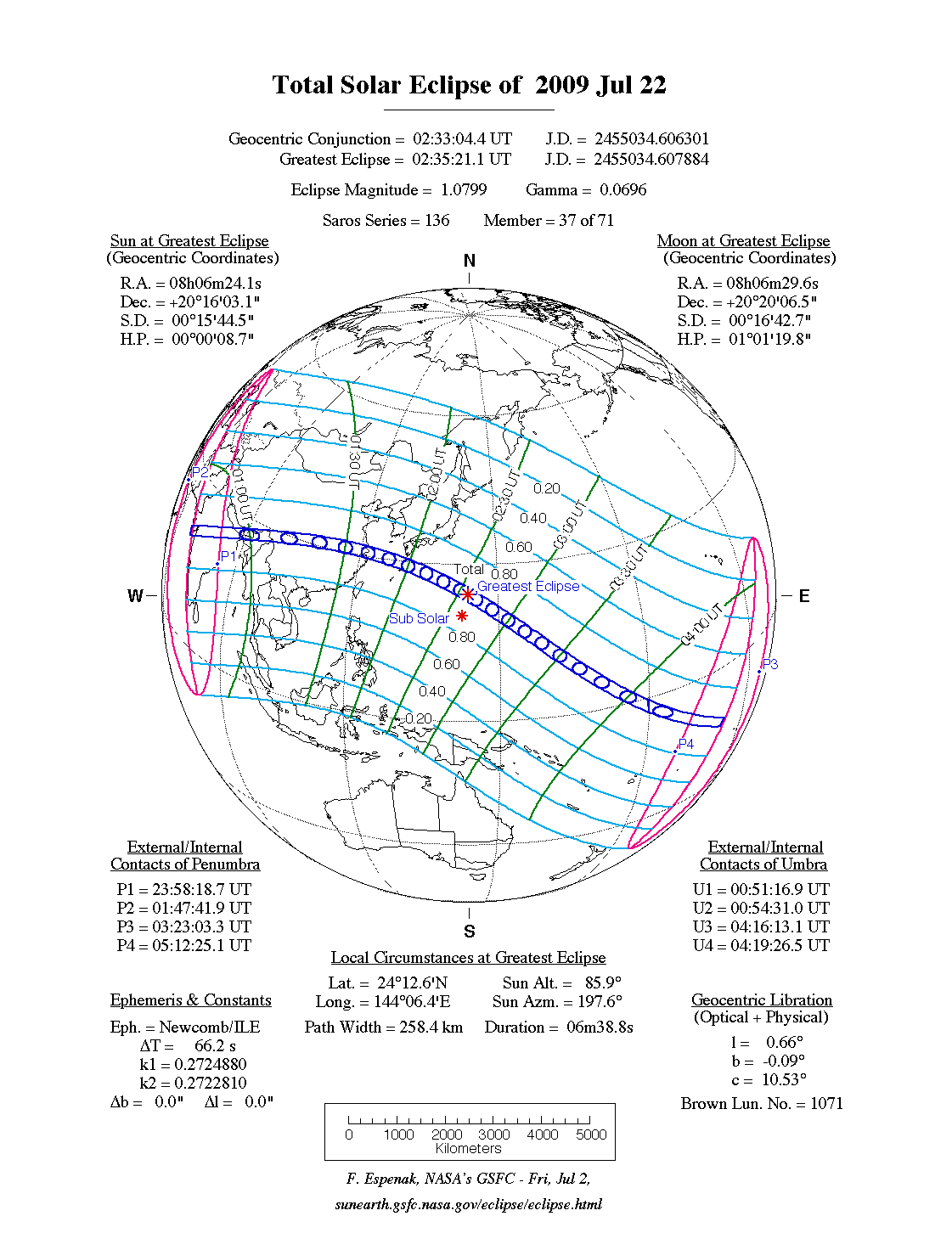
Solar eclipse 2009: Totality crosses eastern Asia


Unfortunately, it is raining quite heavily from 8 am till 9 plus in Singapore today. So it is not possible to view the eclipse.

- wong chee tat :)

Tuesday, July 21, 2009

Singapore to experience minimal effects of upcoming solar eclipse

Singapore to experience minimal effects of upcoming solar eclipse


S’pore to experience minimal effects of the upcoming eclipse

SINGAPORE: Come Wednesday, China, India and Japan will be seeing its longest total solar eclipse in almost 500 years.

But Singapore will have to wait a little longer to experience the full eclipse.

Scientists said Singapore will only experience a partial solar eclipse between 8.40am and 9.40am.

They added that unlike other countries there will be minimal changes to temperature and visibility.

The Singapore Science Centre will be providing special equipment for members of the public to view the eclipse.

It will also have talks about the astronomical phenomenon.

- CNA/vm

- wong chee tat :)

July eclipse is best chance to look for gravity anomaly

July eclipse is best chance to look for gravity anomaly
18:00 19 July 2009 by Phil McKenna

From remote observatories on the Tibetan plateau to a cave in a Shanghai suburb, Chinese researchers are poised to conduct an audacious once-in-a-century experiment. The plan is to test a controversial theory: the possibility that gravity drops slightly during a total eclipse.

Geophysicists from the Chinese Academy of Sciences are preparing an unprecedented array of highly sensitive instruments at six sites across the country to take gravity readings during the total eclipse due to pass over southern China on 22 July. The results, which will be analysed in the coming months, could confirm once and for all that anomalous fluctuations observed during past eclipses are real.

"It sounds like what is really necessary to break the uncertainty," says Chris Duif of Delft University of Technology in The Netherlands. "I'm not really convinced the anomaly exists, but it would be revolutionary if it turned out to be true," he says.

Pendulum anomaly
The first sign that gravity fluctuates during an eclipse was in 1954. French economist and physicist Maurice Allais noticed erratic behaviour in a swinging pendulum when an eclipse passed over Paris.

Pendulums typically swing back and forth as a result of gravity and the rotation of the Earth. At the start of the eclipse, however, the pendulum's swing direction shifted violently (see diagram), suggesting a sudden change in gravitational pull.

Fluctuations have since been measured during around 20 total solar eclipses, but the results still remain inconclusive.

Relative doubt
Most physicists doubt the anomaly's existence, because it would challenge our ideas about how gravity works.

As a result, a number of conventional explanations have been suggested. "There could be different reasons: atmospheric changes in temperature or air pressure, people suddenly moving or not moving, or other sudden changes," says C. S. Unnikrishnan of Tata Institute of Fundamental Research in Mumbai, India.

However, in 2004, Duif posted a theory online concluding that none of the suggested external factors could account for the magnitude and timing of observed anomalies (see www.arxiv.org/abs/0408023).

Best chance
In the run up to July's eclipse, Chinese researchers have prepared eight gravimeters and two pendulums spread across six monitoring sites. The team hopes that the vast distance between the sites (roughly 3000 kilometres (1864 miles) between the most easterly and westerly stations), as well as the number and diversity of instruments used, will eliminate the chance of instrument error or local atmospheric disturbances.

"If our equipment operates correctly, I believe we have a chance to say the anomaly is true beyond all doubt," says Tang Keyun, a geophysicist at the Chinese Academy of Sciences.

The opportunity won't come again soon. At over five minutes, the event will be the longest total solar eclipse predicted for this century. What's more, the event will occur when the sun is high in the sky; a time when, according to Tang, any potential gravitational anomaly should be greatest.

-NS

-wong chee tat :)

Solar eclipse pits superstition against science

Solar eclipse pits superstition against science


MUMBAI (AFP) – Indian astrologers are predicting violence and turmoil across the world as a result of this week's total solar eclipse, which the superstitious and religious view as a sign of potential doom.

But astronomers, scientists and secularists are trying to play down claims of evil portent in connection with Wednesday's natural spectacle, when the moon will come between the Earth and the sun, completely obscuring the sun.

In Hindu mythology, the two demons Rahu and Ketu are said to "swallow" the sun during eclipses, snuffing out its life-giving light and causing food to become inedible and water undrinkable.

Pregnant women are advised to stay indoors to prevent their babies developing birth defects, while prayers, fasting and ritual bathing, particularly in holy rivers, are encouraged.

Shivani Sachdev Gour, a gynaecologist at the Fortis Hospital in New Delhi, said a number of expectant mothers scheduled for caesarian deliveries on July 22 had asked to change the date.

"This is a belief deeply rooted in Indian society. Couples are willing to do anything to ensure that the baby is not born on that day," Gour said.

Astrologers have predicted a rise in communal and regional violence in the days following the eclipse, particularly in India, China and other Southeast Asian nations where it can be seen on Wednesday morning.

Mumbai astrologer Raj Kumar Sharma predicted "some sort of attack by (Kashmiri separatists) Jaish-e-Mohammad or Al-Qaeda on Indian soil" and a devastating natural disaster in Southeast Asia.

An Indian political leader could be killed, he said, and tension between the West and Iran is likely to increase, escalating into possible US military action after September 9, when fiery Saturn moves from Leo into Virgo.

"The last 200 years, whenever Saturn has gone into Virgo there has been either a world war or a mini world war," he told AFP.

It is not just in India that some are uneasy about what will transpire because of the eclipse.

In ancient China they were often associated with disasters, the death of an emperor or other dark events, and similar superstitions persist.

"The probability for unrest or war to take place in years when a solar eclipse happens is 95 percent," announced an article that attracted a lot of hits on the popular Chinese web portal Baidu.com.

Sanal Edamaruku, president of the Indian Rationalist Association, dismissed such doomsday predictions.

"Primarily, what we see with all these soothsayers and astrologers is that they're looking for opportunities to enhance their business with predictions of danger and calamity," he told AFP.

"They have been very powerful in India but over the last decade they have been in systematic decline."

Astronomers and scientists are also working to educate the public about the eclipse.

Travel firm Cox and Kings has chartered a Boeing 737-700 aircraft to give people the chance to see the eclipse from 41,000 feet (12,500 metres).

Experts will be on board to explain it to passengers, some of whom have paid 79,000 rupees (1,600 dollars) for a "sun-side" seat on the three-hour flight from New Delhi.

The eclipse's shadow is expected to pass over the aircraft at 15 times the speed of sound (Mach 15), said Ajay Talwar, president of the SPACE Group of companies that promotes science and astronomy.

"It's coming in the middle of the monsoon season. On the ground, there's a 40 percent chance of seeing it in India. On the aircraft you have almost a 90 percent chance of seeing the eclipse," he added.

Siva Prasad Tata, who runs the Astro Jyoti website, straddles the two worlds.

"There's no need to get too alarmed about the eclipse, they are a natural phenomenon," the astrologer told AFP.

But he added: "During the period of the eclipse, the opposite attracting forces are very, very powerful. From a spiritual point of view, this is a wonderful time to do any type of worship.

"It will bring about good results, much more than on an ordinary day."


What will happen tomorrow?

- wong chee tat :)

Sunday, July 12, 2009

Tuesday, January 27, 2009

Update 2: Annular Solar Eclipse

Here are some of the pictures from various sources that captured the solar eclipse on Jan 26th 2009.


Indonesians among the few to witness solar eclipse

By ZAKKI HAKIM,Associated Press Writer AP - Tuesday, January 27

ANYER, Indonesia - Indonesians were among the few worldwide to witness an eclipse of the sun Monday, but even there the view was hampered in most places by cloudy skies.

Dozens gathered in the western coastal town of Anyer as the moon passed across the sun's path at 4:40 p.m., covering 92 percent of the sun's diameter and leaving a white, flaming ring of fire that lasted about four minutes.

"I'm old, but I still think this is magical," said Roanna Makmur, 66, who drove several hours with eight friends to witness the sight, known as an annular eclipse, because it does not completely black out the sun.

"I can't help but feel the greatness of God," she said, as other onlookers cheered. "Anyone who passed up this opportunity, really missed out."

Annular eclipses, which are considered far less important to astronomers than total eclipses of the sun, occur about 66 times a century and can only be viewed by people in the narrow band along its path.

A relatively small number of people were in the best places to view Monday's eclipse, said Jay Pasachoff, professor of astronomy at Williams College in Williamstown, Massachusetts, and chair of the International Astronomical Union's Working Group on Eclipses.

Aside from several regions in Indonesia, the world's largest archipelago, only villagers on a tiny South Pacific island group known as the Cocos, administered by Australia, were to have been able to see the ring-shaped corona, he wrote in a statement.

A partial eclipse _ with coverage ranging from 1 percent to 84 percent of the sun's diameter _ was to be visible in the southern third of Africa, in southeastern India, and southeast Asia, as well as the western part of Australia.

The last total eclipse of the sun was Aug. 1, 2008, and was visible in Canada, across northern Greenland, the Arctic, central Russia, Mongolia and China.

The next total eclipse will be July 22, 2009, and will be visible in India, Nepal, Bangladesh, Bhutan, Myanmar, China and some Japanese islands.

___

On the Net:

Path details: http://eclipse.gsfc.nasa.gov/OH/OHfigures/OH2009-Fig01.pdf


S’poreans gather at Science Centre, mosque to watch solar eclipse

Channel NewsAsia
Channel NewsAsia - Tuesday, January 27

SINGAPORE : It was the first solar eclipse of the year, and many said it was the clearest seen in 10 years.

More than 6,400 people were at the Singapore Science Centre’s Observatory Centre on Monday to watch the rare phenomenon unfold at about 4.30pm.

However, before the maximum eclipse could be seen, visibility started to dip at about 5.40pm.

Another group of Singaporeans was at the Al—Firdaus Mosque to witness the same natural phenomenon.

They also took part in activities which included calculating and predicting the next solar eclipse.

Experts said the next solar eclipse that can be seen in Singapore will likely be on July 22 this year.

However, it will be not be as vivid as the one on Monday, where observers could see the moon’s shadow covering almost 80 per cent of the sun’s surface.

— CNA/ms

- http://shadowandsubstance.com/

- http://www.eclipse.org.uk/eclipse/0132009/

-http://news.yahoo.com/nphotos/Solar-Eclipse/ss/events/sc/012609solareclipse;_ylt=Al4YpLcEiNY22j_Vd40OBTH9xg8F;_ylu=X3oDMTFmMGM3MmJyBHBvcwMxNwRzZWMDeW5fcl8zc2xvdF9zbGlkZXNob3cEc2xrA3NsaS1ldi1saW5r

- wong chee tat :)

Sunday, January 25, 2009

When red is not auspicious

Sunday January 25, 2009
When red is not auspicious
VASTHU SASTRA
By T.SELVA

The first day of Chinese New Year will see the first solar eclipse of the year, so precautions are recommended amidst all the merry-making.

THE first eclipse of the sun for 2009 occurs tomorrow, the first day of Chinese New Year, and it is a time to be cautious.

This annular eclipse will happen between 4.30pm and 7pm in Malaysia. A dark red shadow will creep across the sun and this can be observed from many countries on this side of the world, including Australia, Bangladesh, Burma, Cambodia, China, India, Indonesia, Singapore, Philippines, Thailand, Sri Lanka, South Africa and Taiwan, as well as our country.

This eerie reddish light is viewed as unfavourable astrologically.

Solar eclipses occur when the moon passes between the Earth and sun. This is an uncommon event because the moon usually remains either above or below Earth’s orbital plane.

The various stages of a solar eclipse.

In astrological studies, any eclipse signals a time to be wary and this is especially true if the sun is involved because all living beings are dependent on the sun for light. There are also subtle eclipses of the moon but its impact on the universe is much less.

Why is a solar eclipse inauspicious? During the eclipse, the power of negative energy increases 1,000 times as compared to other times. When the environment becomes conducive for negative energy to amass, the chances of it affecting people increases.

Since ancient times, the sun has been viewed as an auspicious star and a life force. It is also known as the remover of all obstacles and the giver of health.

It rules the digestive system, heart and blood circulation and influences an individual’s strength, energy, self confidence, leadership and many other qualities.

The impact of the negative energies when the sun is obscured causes a lack of courage, fatigue and low self-esteem.

People are advised not to carry out activities as usual during the eclipse period as they may behave irrationally. Do not view the eclipse directly, and it is better not to travel during the period and stay indoors.

I understand this can be difficult with it being Chinese New Year but revellers should try to take precautions at least during the three-and-a-half hours of the eclipse.

People who were born during an eclipse should take even more care when such cosmic events occur because they will experience the effects of the eclipse more deeply than others.

Pregnant women and senior citizens should be extra careful and should not consume food or drinks during the eclipse period. And newborns should not be exposed to the rays.

Everyday activities that should be avoided during the time of the eclipse are sleeping, conjugal relations, swimming, holding meetings and weddings and all religious or special events.

To ward off the negative rays of the sun, people can use kusha or dharba grass (holy grass used in Hindu rituals). To mitigate the ill effects of the eclipse, the grass should be used as a cushion or placed on the bed and pillow, used in food and beverages, put in vehicles and by the main doorway of the house. (Dharba’s scientific name is Desmostachya bipinnata; in Australia, its common name is halfa grass and in the US, it is known as big cordgrass or salt reed-grass).

After the eclipse, people should wash and clean their houses to remove all “harmful energies” that would have set in and offer prayers.

Although the Jan 26 lunar eclipse is only partial and not like the total eclipse that occurred on Aug 1 2008, people should be careful. The next total eclipse will take place on July 22 and will be visible in India, Nepal, China, Hawaii, and the Pacific Ocean.

This solar eclipse will be the longest total solar eclipse that will occur in the 21st century and will last for up to 6 minutes and 39 seconds.

- wong chee tat :)

Annular Solar Eclipse of January 26 2009

Jan 26

An annular solar eclipse is visible from parts of Africa, Asia, Australia, Antarctica, and the South Pacific. The Sun will form a "ring of fire" around the intervening Moon. It is not visible from North America.

Details:

Annular Solar Eclipse of January 26

The first solar eclipse of 2009 occurs at the Moon's ascending node in western Capricornus. An annular eclipse will be visible from a wide track that traverses the Indian Ocean and western Indonesia. A partial eclipse will be seen within the much larger path of the Moon's penumbral shadow, which includes the southern third of Africa, Madagascar, Australia except Tasmania, southeast India, Southeast Asia and Indonesia. (Figure 1).

The annular path begins in the South Atlantic at 06:06 UT when the Moon's antumbral shadow meets Earth and forms a 363 kilometre wide corridor. Traveling eastward, the shadow quickly sweeps south of the African continent, missing it by approximately 900 kilometres. Slowly curving to the northeast the path crosses the southern Indian Ocean. Greatest eclipse[1] takes place at 07:58:39 UT when the eclipse magnitude[2] will reach 0.9282. At this instant, the annular duration is 7 minutes 54 seconds, the path width is 280 kilometres and the Sun is 73° above the flat horizon formed by the open ocean. The central track continues northeast where it finally encounters land in the form of the Cocos Islands and onward to southern Sumatra and western Java (Figure 2). At 09:40 UT, the central line duration is 6 minutes 18 seconds and the Sun's altitude at 25°. In its final minutes, the antumbral shadow cuts across central Borneo and clips the northwestern edge of Celebes before ending just short of Mindanao, Philippines at 09:52 UT. During a 3 hour 46 minute trajectory across our planet, the Moon's antumbra travels approximately 14,500 kilometres and covers 0.9% of Earth's surface area. Path coordinates and central line circumstances are presented in Table 1.

Partial phases of the eclipse are visible primarily from southern Africa, Australia, Southeast Asia and Indonesia. Local circumstances for a number of cities are listed in Table 2. All times are given in Universal Time. The Sun's altitude and azimuth, the eclipse magnitude and obscuration[3] are all given at the instant of maximum eclipse.

This is the 50th eclipse of Saros 131. The family began with an unusually long series of 22 partial eclipses starting on 1125 Aug 01. The first central eclipse was total in the Northern Hemisphere on 1522 Mar 27. It was followed by 5 more total eclipses before the series produce 5 hybrid eclipses from 1630 to 1702. The first annular eclipse of Saros 131 occurred on 1720 Aug 04. The series will produce 29 more annular eclipses the last of which is 2243 Jun 18. Saros 131 terminates on 2369 Sep 02 after a string of 7 partial eclipses.

- wong chee tat :)